"A Nature Observer′s Scrapbook"
Bugs - True Bugs!
.
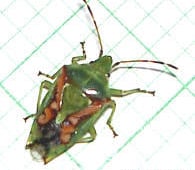
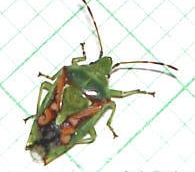
Juniper Shieldbug
Elasmostethus tristriatus
The Juniper Shield Bug is not common in East Lincs but at the end of the long dry summer of 2003, within the space of two weeks, four specimens had been found in the garden. Their favoured habitats are Juniper (as the name suggests) and Cupressus - both of which occur in the garden.
The overall length of this mature specimen was 10.5mm - as verified by the background grid, although some other UK Shield Bug species may grow to 20mm.
Whereas butterflies and moths undergo 'complete' metamorphosis ie the radical change from caterpillar to flying adult, the shield bugs hatch from the egg as small rudimentary versions of the adult and undergo four 'incomplete' metamorphic moults, gradually developing towards the sexually mature adult flying insect.
| Date | Sighting |
| 24.08.2003 | Back garden. |
| 03.10.2004 | One disturbed while trimming Leylandii hedge. |
| 20.10.2004 | One found on an indoor windowsill on a wet, rainy day. |
| 31.01.2007 | One found in garden close to a storm felled Leylandii. |
| 13.06.2007 | One found on long grass under Leylandii. |
.
Woundwort Shieldbug
Eysacoris fabricii
Shield Bugs are true bugs, part of the Heteroptera group.
All are vegetarian and each species is usually identified with one particular foodplant. However the first specimens of this species that I found (seen upper right) were on White Dead Nettle which, in the absence of the later maturing Woundwort, I presume is the next best thing.
These adults are only about 8mm in length.
Three groups of newly hatched nymphs were later found in groups of 7, 8 and 12, each group on a separate Woundwort plant. It is normal for the first stage nymphs (barely 2mm long) to remain close to their egg cases until they undergo their first moult.
Further monitoring of their development was thwarted by heavy rain which washed the evidence away.
Through a lens it was just possible to make out a series of dark dots along the side of the abdomen, similar to those on the adult bugs.
In September I came across the final stage of the incomplete metamorphosis when I found a new adult emerging from its final instar shell (lower image). Pale and creamy translucent, it was very sluggish. But within 15 minutes it was walking briskly away. After a further 45 minutes it began to 'colour up', the head, and scutellum darkening and dark dots appearing around the edge of the abdomen.
| Date | Sighting |
| 10.05.2004 | Found on White dead nettle in the shelter of a hawthorn hedge. TF 305 660 |
| 31.05.2004 | Found on Woundwort (!) in the shelter of a hawthorn hedge. TF 305 660 |
| 05.06.2004 | This must be a good year for them. I found seven on one Woundwort plant. Three conjoined pairs and a singleton. |
| 30.06.2004 | Newly hatched nymphs found, still close to egg cases on the upper side of Woundwort leaves. |
| 15.05.2005 | 2 found on Bramble leaves adjacent to young Woundwort plant in same area as last year. |
| 16.05.2005 | 2 found mating on Woundwort plant by stable hedge. |
| 16.09.2005 | Small colony of three adults, one newly emerged adult and one final instar found on the same plant as mentioned in the previous record. |
| 22.06.2006 | First of the year seen close to some eggs in SW corner of hedge. |
| 07.06.2007 | Eight conjoined pairs and a seven singletons found within the space of 20m. |
.
Pied Shieldbug
Sehirus bicolor
This distinctive little 7mm long shield bug feeds on White dead nettle.
The female lays her eggs in the ground and tends to them and the hatched nymphs until they are feeding for themselves. This caring behaviour is not all that common among insects.
The series of images indicates the transformation that occurs during the various stages of incomplete metamorphosis.
On hatching, the tiny first instars remain close to the egg cases and may not feed at all prior to the first moult. The upper image is of an early instar - probably stage 2. The search for food causes the family group to disperse.
The middle image probably represents the next stage of development. Rudimentary wing cases are beginning to appear.
The bottom image is of the mature adult which will have hibernated through the winter, seen in May, early in the season, on nettles. In favourable years there may be two generations.
| Date | Sighting |
| 21.07.2004 | Burton's paddock - western hedge. |
| 25.05.2005 | On nettles in roadside ditch opposite front door. |
.
Forest Shieldbug
Pentatoma rufipes
These shieldbugs are normally found on oak and alder trees but, can be common on garden fruit trees as well where the damage they cause can render the fruit inedible.
Eggs are normally laid in August. The yellow and black nymphs hibernate over winter in cracks in the bark of the tree and on awakening in spring adopt a varied diet of leaves and caterpillars.
After several instar moults, the adults appear in July, retaining their omnivorous, meat and veg diet, and can reach 16mm overall length.
One of the identifying features of this Shieldbug is its squared off 'shoulders'.
| Date | Sighting |
| 25.08.2004 | Dropped on the back of my neck as I was weeding under a flowering cherry tree. |
.
Birch Shieldbug
Elasmostethus interstinctus
As per its name this one favours birches - and we have a compact Betula pendula in the garden.
The female lays eggs in May and June which generally hatch in August. So the 11mm, mature specimen found in August must have been a year old.
The immature instar, probably second or third instar stage since the wing buds are barely discernable, was found crawling on my sleeve after I brushed past the Betula pendula. But, the surprising thing was that this was in early October so the conclusion has to be that this was an unusual second generation hatch. - More evidence of global warming?
Whether it will be able to feed up before the frosts cause the leaves to fall remains to be seen. But, at only 4mm I wouldn't give much for it's chances of survival.
| Date | Sighting |
| 26.08.2004 | Flew in through back door, attracted to light. |
| 03.10.2006 | 2nd or 3rd stage instar found on clothing after brushing past Birch tree. |
.
Hawthorn Shieldbug
Acanthosoma haemorrhoidale
This has to be the bug that inspired the 'Stealth Bomber' design.
This 16mm shieldbug is common in England and Wales - but not so common in Scotland.
Their food of choice is, as the name implies, Hawthorn berries and leaves but, they can be found on other trees. They have no biting or chewing mouthparts but have a long drinking straw type 'sucking tube' with which they probe for juices. This is normally carried, tucked up, close to the under-body when not in use.
Their camouflage is remarkably good and until you 'get your eye in' they can be quite difficult to find. But, in the autumn, when the berries (haws) are on the hawthorn, it is worthwhile looking around berries that have been damaged or half eaten. You may just 'get lucky'.
There is one generation a year and although the adults will hibernate during the coldest winter weather, the one in the lower image was active on 19 January 2007.
The young bugs (nymphs) go through several instar phases before reaching adulthood. Each phase involves a moult, an increase in size and a developmental progression to sexually mature adulthood. An adult Hawthorn Shieldbug will reach about 15mm in length. The nymph in the lower image, at about 5mm was probably in a 3rd instar phase.
| Date | Sighting |
| 27.09.2004 | Found on fence post in the lea of the hawthorn hedge. |
| 31.08.2006 | 3rd instar found on Stinging nettles under Hawthorn hedge. |
| 03.09.2006 | Benniworth Moor car park plantation. |
| 19.01.2007 | Found close to the 2004 sighting on a mild January day. |
| 02.02.2007 | Another found close to the previous sighting. |
Green Shieldbug
Palomena prasina
In the UK, the Green Shieldbug is unique in having a plain green appearance with no other markings other than the dark straw coloured wing tips terminating the hard wing cases. However, in continental Europe there is another similar plain green species, Palomena viridissima. They can be differentiated in the adult stage by P. prasina having a marginally concave forward edge to the pronotum (either side of the head) while P. viridissima has a more rounded convex forward edge.
Their plain green appearance is remarkably effective camouflage as they roam over a wide range of herbaceous plants - their body segment lines and edges blending very effectively with plant leaf veins.
In the autumn the adult shieldbugs (up to 14mm in length) compensate for the dying back of lush foliage, by changing their green appearance to deep brown allowing them to merge with fallen leaves and dead wood and they will over-winter in this state. But when spring arrives and new plant growth appears, they revert to their summer green colouring. This seasonal colour change is seen in several animal, bird and insect species.
Batches of eggs are laid in early summer (usually on the underside of leaves) when good lush foliage ensures a ready food supply and usually hatch within 7 to 10 days. Tiny little first instar nymphs emerge and usually remain close to their egg cases. Bacteria on the egg cases may be their only food supply for a few days until they undergo their first moult. Each instar moult results in a change of shape, size and colour so it is often difficult to guess what each small insect will turn out to be.
The third image is of a 2nd instar, only 3mm long. At this stage, the nymphs start to disperse and forage independently. The prominent black banding is common to several shieldbug species at this stage.
The 3rd instar (not shown) is larger and the black banding is reduced in area. The 4th instar (not shown) appears like a little flat circular disc and again may not be recognised as a shieldbug. But, in the 5th instar (lower image) it is possible to see the formation of the wing buds developing either side of the 'V' shaped scutellum in the middle of the back.
The development cycle from egg to adult can be completed in about six weeks. And, weather permitting, may allow two generations to mature in a year.
| Date | Sighting |
| 25.07.2006 | Retrieved 5th instar found floating in water filled ditch - and released. |
| 09.08.2006 | 2nd instar found on White Dead Nettle. |
| 01.09.2006 | 2 adults found under Cupressus hedge - presumably from nearby Nettles. |
| 26.01.2007 | Brown adult found on fallen branch of Cupressus tree. |
.
Shieldbug
Troilus luridus
Should you ever go looking for images of this Shieldbug, you will find that in it's early stages of development it is a striking and very colouful insect with very contrasting markings - lurid as its name suggests.
Conversely the adult, when viewed in shade, is dull, nondescript and very well camouflaged. It is only in full sunlight or under photographic flashlight (as seen here) that it's irridescence is seen to full advantage.
Whereas most shieldbugs are strictly vegetarian, this one is omnivorous, sucking the juices of beetle larvae and caterpillars as well as plants.
Its quest for beetle larvae means that it is more likely to be found in wooded areas or around piles of decaying timber.
At 10 - 12mm in length (this one was 11mm) this species falls within the mid range of UK Shieldbugs.
| Date | Sighting |
| 04.11.2006 | Found on sunny side of Hawthorn hedge after a frosty night. |
Turtle Bug
Podops inuncta
The Turtle Bug is not a well recorded species. This is hardly surprising considering its small size ( 6mm ) and its relatively dull uniform colouring - and the fact that its normal habitat is grassland where concealment is no problem. In the UK it is regarded as a 'southern counties' species and only a dozen or so specimens have so far been recorded in Lincolnshire.
In most shieldbugs the 'V' shaped scutellum which divides the wings is usually quite prominent. But, in the case of the Turtle Bug it has developed as a broad shield-like plate almost completely covering the upper abdomen.
Its unique identifying feature are the two little spurs or horns that project forward from the pronotum, either side of the head. They may seem obvious enough in the image but being only 0.25mm long they can easily be overlooked or dismissed as debris with the naked eye.
| Date | Sighting |
| 15.04.2007 | Found at rest on the side of the garage wall. |
.
Common Froghopper
Philaenus spumarius (?)
With something like ten different species of similar looking 'froghoppers' or 'spittle bugs' the amateur should be cautious of labelling them with specific scientific names (hence the question mark after the species name).
Philaenus spumarius tends to be found on a wide range of low growing plants such as grasses, herbaceous plants and shrubs from June to September.
They are usually uniformly brown in colour but mottled versions are also to be found.
This is one of the bugs responsible for all that frothy 'cuckoo-spit' that gardeners find so objectionable. It is the nymphs that produce the 'froth' to protect themselves while they are in their very vulnerable, soft bodied and slow moving, juvenile state.
The adults are small, up to 6mm in length and rely on their ability to 'hop' (very effectively) from danger.
And their colloquial similarity to frogs comes from the flat frog-like head.
| Date | Sighting |
| 04.07.2004 | Adult on stinging nettles. |
| 26.09.2004 | Adult on grass. |
.
a 'Spittle bug'
Aphrophora alni (?)
Very similar in shape to the previous species but twice the size at up to 12mm in length. This species tends to be found on taller growing vegetation such as shrubs and trees from May to October.
Although seen here with mottled wings, that should not be assumed to be a distinguishing feature. The mottling can be very variable and plain specimens may be found. Searching for distinguishing features in similar looking species can be confusing unless one can examine examples side by side. But this one tends to have a more prominent ridge (keel) running down its back.
In its larval state, this bug also produces froth (spittle) to protect itself from predators while it nibbles and sucks sap from the plant.
The adults rely on their ability to 'hop' (spring) from danger before opening their wings to fly off.
| Date | Sighting |
| 16.05.2004 | Adult on Salix cprea tree. |
.
Red and Black Froghopper
or, ....... Black and Red Froghopper
Cercopis vulnerata
Not the most common but certainly the most striking of the froghoppers. This is one of the 'true bugs' or Homoptera. This species is found in central and southern England and the colourful mature adults appear for (what seems to me) a very short while in early summer. Other adult froghopper species can be found through to late summer.
The early nymphal stages of this species are spent underground feeding on plant roots. The nymphs undergo several skin changes during incomplete metamorphisis before reaching mature adulthood.
The froghoppers are sap suckers at all stages of their development, some being regarded as pests by gardeners. They get their colloquial name from the ability to leap quite suddenly when danger threatens.
| Date | Sighting |
| 13.05.2004 | Two insects found on east and west roadside verges. |
| 02.06.2005 | Hay Meadow western hedge. |
| 08.06.2006 | One seen Hay Meadow Southern hedge. |
.
Ground bug
..... no common name
Aphanus rolandri
One might be forgiven for thinking this is 'another little black beetle'.
At only 8mm long, 'little' it certainly is. But you don't see many beetles with only one central mark on their wing cases.
And closer inspection shows that the mark is actually abdomen colour showing through membranous wings. And that directs one to the Heteroptera Bugs.
Superficially, Aphanus rolandri looks similar to the Mirid and Capsid leaf bugs, but, as one might expect, 'ground bugs' are invariably found at ground level. This one feeds on fallen seeds and favours dry sandy areas. Since my area cannot be classed as sandy, I can only presume that my specimen is a descendant of bugs that had arrived in bags of sand delivered many years previously.
The coloured spot can vary from yellow to red.
| Date | Sighting |
| 27.08.2006 | Found close to a longstanding sand store. |
.
Nettle Ground bug
Heterogaster urticae
Nettle Ground bugs can be active all year round - I found this one on the last day of November, but in severe weather they have the sense to seek shelter and remain dormant until the temperature warms up again.
As their common name implies, they feed on the stinging nettle Urtica dioica and in late spring will congregate in the new foliage to mate.
With many similar looking bugs, the clue to this ones identity lies in its banded legs.
| Date | Sighting |
| 30.11.2006 | Crept out of hibernation while inspecting damp rotten wood. |
| 05.04.2007 | Found wandering on outside door.. |
Tree Damsel bug
Himacerus apterus
In the UK, the Tree Damsel bug and the Ant Damsel bug (Himacerus mirmicoides) look superficially quite similar. Fortunately there are body characteristics which help to separate them.
The antennae of the Tree Damsel bug are about as long or longer than its body (thorax and abdomen) length and the basal antenna segment is as long or longer than the head. In the Ant Damsel bug the antennae are significantly shorter than its body and the basal segment is also shorter than the head.
Even in the adult (as seen in the image) the wings are quite short. In the Tree Damsel bug they will only reach to the third abdomen segment. In the Ant Damsel bug the wings reach down to the fifth abdomen segment.
And finally, one would expect to find the Tree Damsel bug on trees - and the Ant Damsel bug in low level herbage. Although there was a tree nearby, this one was found halfway up a stone pillar!
Both species are omnivorous, preying on small insects when available or sucking sap from plants through their long proboscis.
| Date | Sighting |
| 25.08.2007 | Found on a stone pillar near a Salix caprea tree. |
.
Potato Capsid bug
Calocoris norvegicus
The Potato Capsid (a true Miridae bug) is a minor pest of potatoes but by way of compensation, it is just as happy feeding on nettles, thistles, ragwort, clover and, as seen upper right, on Hedge Mustard.
The Common Capsid is a very similar green bug but, the key to positive identification of the Potato Capsid lies in the two brown dots on the pronotum region just behind the head.
Early instars tend to appear uniformly green but after the final metamorphic moult the adult insect emerges quite pale and will take some days to develop mature colouration.
| Date | Sighting |
| 01.08.1999 | Back garden. |
| 04.07.2004 | Hay meadow western hedge on nettles. |
| 16.07.2004 | Hay meadow western hedge on Hedge Mustard. |
.
Red Spotted plant bug
Deraeocoris ruber
I found many of these, about 8mm long, chiefly on White Dead Nettle.
What I found confusing was that there appeared to be many subtle variations in colouring.
These ranged through to a version which was almost completely black with red spots. It is tempting to suggest that this might be due to the natural maturing process since the darker specimens also appear to be slimmer - less mature?
....... or, it may be that the darker slimmer models are the males.
Of course there is also the real possibility that they may be an entirely different species!!! A similar, slightly larger species, D. olivaceus, can be identified by thin, contrasting 'rings' on the tibia, the long middle segments of the legs.
Both adults and nymphs feed on aphids and other small insects.
Adults will be seen July to September. The eggs overwinter to hatch in the Spring.
| Date | Sighting |
| 10.08.2004 | Active on White Dead Nettle throughout August and September. |
.
- no common name
Liocoris tripustulatus
First time I saw this striking mirid bug, I named it 'The Golden Heart bug'. It really is quite distinctive. About 6-7mm long.
It is reputed to favour nettles but I have seen it on both Red Currant and Salix caprea.
In this species, the adults overwinter, mating occurs during May and June, after which the males die off. But the females survive until the new generation adults appear. It is therefore possible to find adults all year long, albeit in different colour forms. Entering hibernation they will be pale brown but by Spring will be rich chocolate brown with orange spots before changing to black and gold for the summer
They are entirely vegetarian.
| Date | Sighting |
| 06.06.2004 | First spotted on Red Currant bushes. |
| 26.05.2005 | On nettles, Hay meadow western hedge. |
.
No common name
Heterotoma merioptera
This small member of the Miridae (Capsid) family (only about 5mm long) is quite common in southern England. It is to be found on a wide range of vegetation (seen here on White Dead Nettle) and feeds on aphids, other small insects and also flower buds and unripe fruits.
When viewed directly from above, it appears to have conventional thin antennae but, a side view reveals the broad paddle-like second segment which readily identifies it.
A second feature is that it appears to glide over green vegetation as its green legs merge into the background.
As it poses here to show off its antennae and green legs, the light reflecting off its wing cases makes them appear quite silvery whereas they are almost black.
| Date | Sighting |
| 26.07.2004 | Found on White Dead Nettle in garden hedge. |